
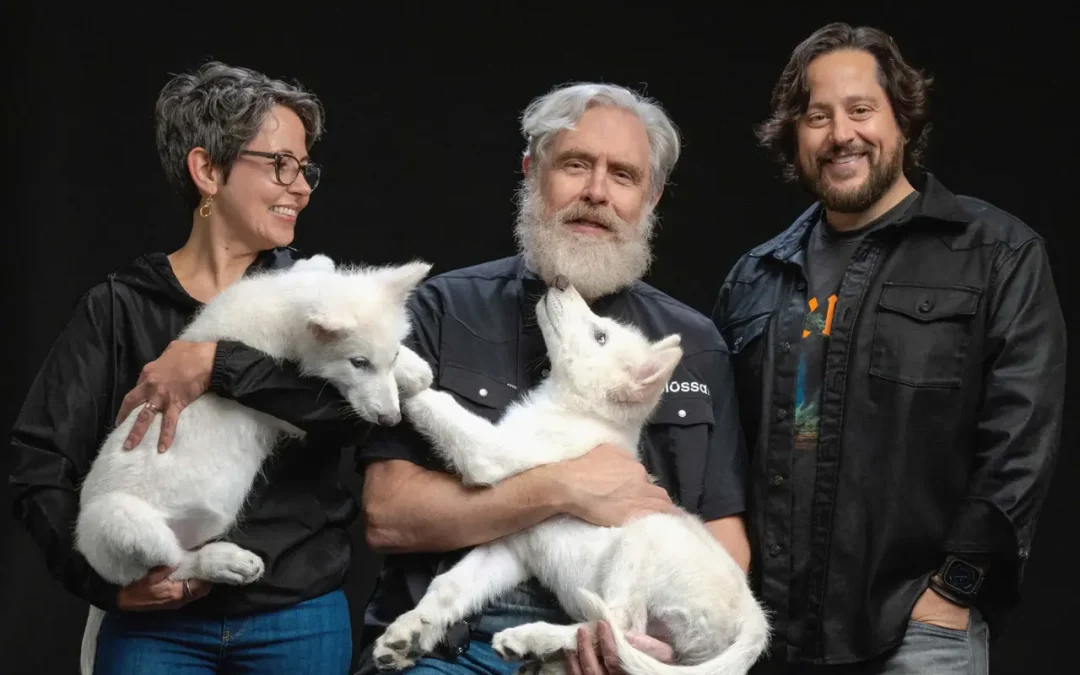
Ben Lamm (right) co-founded Colossal Biosciences with Harvard geneticist George Church (center) in 2021
By Futurist Thomas Frey
In April 2025, three wolf pups were born that shouldn’t exist.
Their names were Romulus, Remus, and Khaleesi. They were healthy, they were photographed, and they made the cover of Time magazine. They were also, genetically speaking, something the world hadn’t seen in 13,000 years. The dire wolf — the apex predator of the Ice Age, the creature that once ruled North America alongside the woolly mammoth and the saber-toothed cat — had been gone since before recorded human history.
Then Ben Lamm brought it back.
Peter Diamandis, who has spent his career finding the most audacious things happening in science and technology, called it the scientific miracle of the decade. He’s not given to overstatement.
But here’s the thing most people missed in all the excitement: the wolf wasn’t the goal. It was the proof.
What They’re Actually Building
Ben Lamm co-founded Colossal Biosciences with Harvard geneticist George Church in 2021. When he announced that the company intended to bring back the woolly mammoth, most people assumed it was a publicity stunt — a flashy headline wrapped around a research project that would never really get anywhere.
They were wrong about that.
What Lamm understood from the beginning is that you don’t build a company around an animal. You build it around the tools you need to get to the animal. And those tools — new ways to read ancient DNA, new methods for editing genes with surgical precision, new technology for growing embryos outside a living body — those turn out to be useful for a lot more than bringing back one extinct species.
Think of it this way. When NASA developed materials that could survive the heat of reentry from space, those materials didn’t stay in rockets. They ended up in everything from firefighting gear to running shoes. The technology built for one extreme purpose found its way into everyday life because the underlying science was genuinely new and genuinely powerful.
That’s what Colossal is doing with biology. The de-extinction projects are the extreme purpose. The tools being built to achieve them are the real product.

Extinction isn’t permanent anymore. With $10B backing and gene editing breakthroughs, life itself is becoming programmable—revived, redesigned, and repurposed at a scale we’re just beginning to grasp.
The Numbers Tell the Story
By January 2025, Colossal had raised $435 million in total funding. A $200 million Series C round valued the company at $10.2 billion, making it Texas’s first decacorn — a startup worth more than ten billion dollars. The investor list includes venture capitalists, institutional funds, and more than a few celebrities whose names you’d recognize. That’s not an accident. Lamm has always understood that a company trying to do something this large needs cultural momentum, not just scientific credibility.
But the science is what earns the valuation. To bring back the dire wolf, Colossal’s team extracted usable DNA from a 13,000-year-old tooth and a 72,000-year-old ear bone. They reconstructed the genome, identified the 20 key traits that made a dire wolf a dire wolf, and rewrote 14 genes in 45 engineered eggs. Those eggs became embryos. Those embryos were carried by surrogate hound mixes. Those surrogates gave birth to three healthy pups.
It worked. On the first attempt at this scale. That is not a small thing.
The mammoth program has already produced what the team calls “woolly mice” — ordinary lab mice gene-edited with mammoth DNA traits, including the distinctive shaggy tawny fur — as a proof that the genetic approach works before they try it on something the size of a bus. The Tasmanian tiger program has reconstructed a 99.9% accurate genome from a 110-year-old skull. A partnership with filmmaker Peter Jackson and the indigenous Māori people of New Zealand is underway to attempt to bring back the moa, a giant flightless bird that disappeared after human settlement of the islands.
Each project is different. Each one pushes the tools further. And each time the tools get pushed further, they get more useful for everything else.
The Part Nobody’s Talking About
There’s a piece of the Colossal story that gets almost no attention in the mainstream coverage, but that may turn out to matter more than the animals themselves. It’s the artificial womb program.
Here’s the problem it solves. To bring back an extinct species, you usually need a living relative that’s close enough in biology to carry the embryo. For the woolly mammoth, that relative is the Asian elephant. But the Asian elephant is itself endangered — and Lamm has been consistent and clear that Colossal will not put endangered animals through invasive reproductive procedures to serve the mammoth project. So they’re building a womb instead. An artificial one. A device that can take a fertilized single-cell embryo and bring it all the way to a live birth without a living surrogate.
Lamm has said publicly that he expects this to work — with a small mammal first, then scaling up — by the end of 2026. If it does, the implications go well beyond anything Colossal is currently working on. A technology that can grow a living mammal from a single cell to birth in an artificial environment is not a tool that stays in one laboratory. What it means for the survival of critically endangered species, for the future of reproductive medicine, for conservation biology across the board — that conversation is only just beginning.
Lamm has drawn a clear line: Colossal won’t apply this technology to humans or non-human primates. But drawing a line around your own use of a tool doesn’t make the tool disappear. It just means someone else will eventually have to decide where to draw theirs.

Startup speed meets science—extinction is shifting from fate to choice. What once took decades now happens in years, turning resurrection into a commercial, repeatable reality.
A Tech Company Wearing a Lab Coat
What makes Lamm’s approach genuinely different from how science normally works is that he’s running Colossal the way he ran his software companies. Fast. Capital-intensive. Outcome-focused. Willing to hire the best people from academia and pay them what the private sector pays, which is not what universities pay. Willing to fail publicly and talk about it openly, which scientists are not traditionally trained to do. And obsessively focused on the question of how the technology gets commercialized — because without a business model, there is no mission.
The result is a company that has moved faster in four years than the academic de-extinction community moved in twenty. That’s not a criticism of the scientists who came before. It’s a description of what happens when you apply startup discipline to a problem that used to live entirely inside universities.
The dire wolf is alive. The woolly mouse exists. The Tasmanian tiger’s genome is reconstructed and waiting. These are not predictions about the future. They are things that have already happened.
The mammoth is next. And after that, if Ben Lamm has his way, extinction itself becomes optional.
Next week: Form Bio — the AI scientific software platform that Colossal built for itself, then realized the entire life sciences industry needed.
Related Reading
Dire Wolf De-Extinction: The Science Behind Colossal’s Breakthrough
Science — A rigorous look at the genomic methodology behind the dire wolf project, what the science actually claims, and where skeptics draw the line between restoration and approximation
Colossal Biosciences’ $10.2 Billion Bet on De-Extinction
MIT Technology Review — How a genomics startup became a decacorn, what the capital structure reveals about where biotech investment is heading, and why the mammoth is the last thing on investors’ minds
Pleistocene Park and the Climate Case for De-Extinction
The Atlantic — The ecological argument for restoring megafauna to Arctic grasslands, and whether the return of large herbivores could meaningfully slow permafrost melt — the climate rationale beneath Colossal’s flagship project