
By Futurist Thomas Frey
Here’s a number that deserves more attention than it gets.
Up to 10,000 species go extinct every year. Not every decade — every year. Scientists call what’s happening right now the sixth mass extinction, and unlike the five that came before it, this one has a clear cause. Us. Human activity — habitat destruction, climate change, invasive species, pollution — has pushed the rate of extinction to more than 100 times the natural background level. The natural world is disappearing faster than any previous generation of humans has witnessed, and most of us are barely aware it’s happening.
Ben Lamm is aware. He’s been aware for years. And while Colossal Biosciences gets most of the headlines for what it does — bringing back extinct animals — the Colossal Foundation, the nonprofit that operates alongside it, may be doing something more immediately important: trying to make sure we don’t lose what we still have.
The Insurance Policy
In October 2024, Lamm launched the Colossal Foundation as a 501(c)(3) with $50 million in initial funding. By the end of 2025 he’d doubled that to $100 million. The mandate is broad — using Colossal’s technologies for conservation globally — but the centerpiece is a concept Lamm describes with characteristic directness.
“You need to have a biobank of every single species,” he told The Hollywood Reporter. “Kind of like a 2025 and beyond Noah’s Ark. We need that on a cellular level.”
A biobank, in this context, is a cryogenic repository of genetic material. Tissue samples. Cell lines. DNA. Preserved at temperatures cold enough to keep biological material viable indefinitely — a physical archive of life, stored against the possibility that it might one day need to be used.
The idea isn’t entirely new. Seed banks have existed for decades. The Svalbard Global Seed Vault, buried in Arctic permafrost, holds nearly 1.4 million seed varieties as insurance against agricultural catastrophe. What Colossal is building is the equivalent for animal life — not seeds, but cells. Not plants, but the full biological heritage of species that are still alive today but may not be for long.
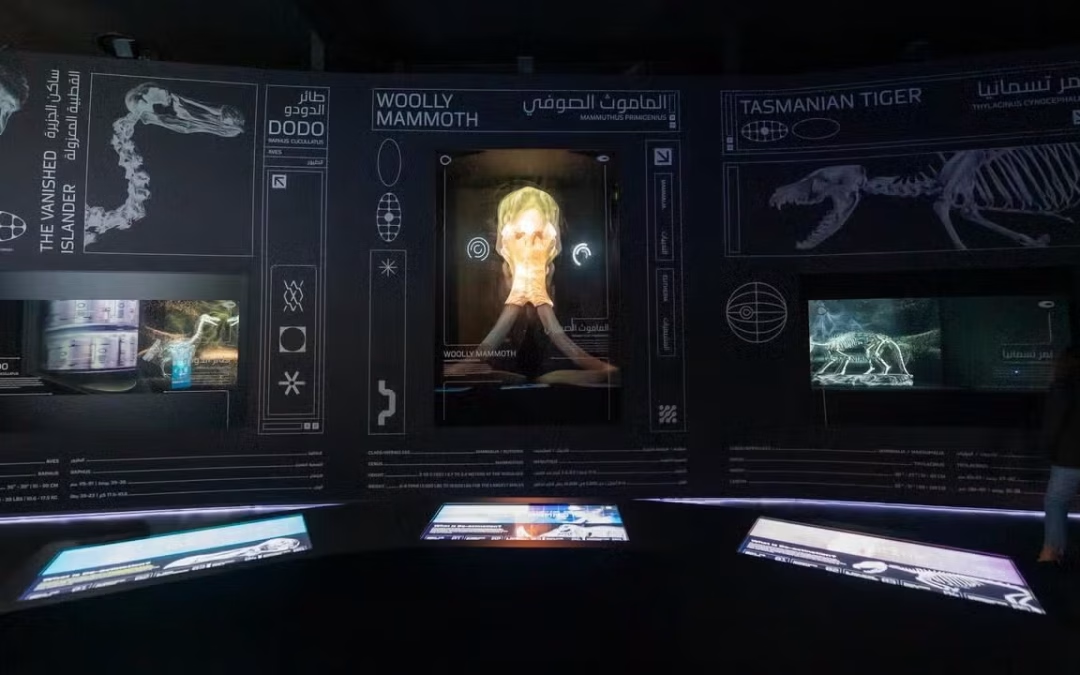
The infrastructure for this is called the Colossal BioVault network — a distributed system of biobanking facilities designed to store cell lines within the countries where the species actually live, respecting national sovereignty and local scientific capacity while building a global genetic safety net. In February 2026, Lamm launched the world’s first BioVault at the Museum of the Future in Dubai, at the World Governments Summit, specifically because he wanted the facility to have an educational component. He wanted children to be able to walk in and understand what it is and why it matters.
“I do not believe that people understand the extinction crisis we’re in,” he said at the summit. “We are in the sixth mass extinction, which is being accelerated by man.”

Ben Lamm building a prototype of the Colossal BioVault
What’s Already Happened
The Foundation isn’t just building infrastructure. It’s already doing the work.
In 2025, it successfully cloned four ancestral “ghost wolves” from the American Gulf Coast — individuals carrying up to 72% red wolf ancestry, representing some of the last remaining genetic threads of one of the most endangered wolf species on Earth. The red wolf recovery program had been struggling for years with hybridization, declining numbers, and institutional stagnation. Colossal’s non-invasive cloning technology — which isolates what are called endothelial progenitor cells from blood rather than requiring invasive procedures — gave conservationists a new tool that the existing program simply didn’t have.
The Foundation also produced the first complete red wolf reference genome, which is the foundational genetic map that future restoration work will rely on. And it backed the development of the world’s first mRNA vaccine for elephant endotheliotropic herpesvirus — EEHV — a disease that has been killing young Asian elephants with no effective treatment for decades. When two vaccinated elephants at the Cincinnati Zoo were naturally exposed to the virus in 2025, both showed no illness and recovered fully. That is not a footnote. That is a vaccine working exactly as hoped on one of the most imperiled large mammals on Earth.
The Foundation committed $3 million to fighting chytrid — a lethal fungal disease attacking amphibian populations globally that Lamm describes as one of the biggest drivers of extinction most people have never heard of. It partnered with the Karankawa Tribe of Texas to honor the cloning of the first red wolf pup with an indigenous naming ceremony. It acquired ViaGen Pets and Equine — the world’s leading animal cloning company, which has already successfully cloned 15 species with a success rate approaching 80% and biobanked more than 40 species including rhinos and critically endangered rodents — and brought its entire operation under the Foundation’s conservation umbrella.
The Logic Behind the Insurance
There’s a phrase Lamm comes back to repeatedly in interviews: it’s always cheaper and easier and more efficient to protect a species than to bring it back. De-extinction is extraordinary. It proves what’s possible. But it’s also the most expensive, most time-consuming, most technically demanding option on the menu. The BioVault network and the Foundation’s biobanking work exist specifically to avoid ever needing to use those options.
The analogy that makes the most sense is fire insurance. You buy it not because you expect your house to burn down, but because the cost of the policy is so much lower than the cost of losing everything. A biobank is the same idea at planetary scale. The cost of preserving a species’ genetic material while it still exists is a fraction of the cost — scientific, financial, moral — of trying to reconstruct it from ancient DNA after it’s gone.
The Foundation is building that policy for every species it can reach. The “Colossal 100” list — the 100 most imperiled species it has committed to biobank — hasn’t been publicly released, but the current project list includes the Sumatran rhinoceros, the northern white rhino, the vaquita, the Javan rhino, the northern quoll, the pink pigeon, and the African forest elephant, among others. These are animals that are, right now, slipping toward the kind of genetic bottleneck that makes recovery enormously difficult even with the best tools available.

From revival to prediction, a system emerges: make extinction optional. The ambition is enormous—but what’s already been built proves speed may be the only thing that matters.
Why This Is the Piece That Makes Everything Else Make Sense
We’ve spent four weeks in this series tracing the architecture of what Ben Lamm is building. Colossal is the genomic platform. Form Bio is the scientific software. Breaking is the ecosystem cleanup tool. Astromech is the predictive intelligence layer.
The Foundation is the mission statement.
Everything else — all the technology, all the capital, all the scientific breakthroughs — points toward a single underlying goal: a world in which biodiversity is not simply allowed to collapse because no one was organized enough, or fast enough, or technically capable enough to stop it. A world in which extinction is, as Lamm has said, optional. Not inevitable.
That’s a large ambition. Large enough that you could be forgiven for being skeptical of it. But look at what has actually happened in five years. Three dire wolf pups are alive. A mRNA vaccine is protecting Asian elephants. The genome of the Tasmanian tiger is reconstructed. A microbe is eating plastic in a laboratory. A predictive biology platform is being built from the world’s most comprehensive genomic database. A network of genetic vaults is spreading across the globe, starting at the Museum of the Future in Dubai.
None of this was inevitable. All of it required someone deciding to build it — and then actually building it, faster than anyone thought was possible, in a way that generated real science and real tools and real outcomes.
The sixth mass extinction is the most important story nobody is paying sufficient attention to. The Colossal Foundation is not going to stop it alone. But it is doing something that most of the conservation world hasn’t managed to do: it’s moving fast enough to matter.
And in a crisis measured in species lost per year, fast enough to matter is the most important thing there is.
Related Reading
The Sixth Mass Extinction Is Here. What Does That Mean?
National Geographic — A clear-eyed look at the scale and pace of the current extinction crisis, the human drivers behind it, and why scientists consider it the defining environmental challenge of our time
What the Svalbard Seed Vault Teaches Us About Preserving Life
Smithsonian Magazine — The story of the world’s most famous genetic insurance policy, and what it reveals about the logic — and the limits — of trying to preserve biodiversity through cold storage
Can De-Extinction Save Ecosystems — or Just Species?
Yale Environment 360 — The ecological argument for restoration biology: whether returning lost species can genuinely repair damaged ecosystems, and what the science actually says about keystone species and biodiversity recovery