

By Futurist Thomas Frey
From data center perimeters to military forward positions, four-legged robots are reshaping what security means — and raising questions nobody has fully answered yet
Man’s New Best Friend
In November 2024, a photograph surfaced that quietly captured the state of where we are: a Boston Dynamics Spot robot, deployed by the U.S. Secret Service, patrolling the grounds of Mar-a-Lago ahead of the then-President-elect’s arrival. Four legs. No face. Sensors where eyes would be. Moving with that slightly uncanny fluidity that robot dogs have — efficient, tireless, and completely indifferent to the Florida heat.
Nobody issued a press release. The image just appeared, circulated briefly, and then the news cycle moved on. But that moment was more significant than it was treated as being. The robotic dog had arrived not as a novelty or a demonstration — but as operational infrastructure, quietly normalized, deployed at the highest level of executive protection in the country.
That normalization is accelerating rapidly. What began as viral YouTube videos of a four-legged machine opening doors and dancing to “Uptown Funk” has become a serious, growing industry with billion-dollar implications across private security, critical infrastructure, law enforcement, and military operations. The robotic dog is no longer a curiosity. It is a platform — and the question of what gets mounted on that platform is one of the more important technology policy conversations of this decade.
What They Can Already Do
The two dominant platforms in the current market are Boston Dynamics’ Spot and Ghost Robotics’ Vision 60. Spot, the more commercially ubiquitous of the two, weighs roughly 75 pounds — about the size of a German Shepherd — and runs on battery power for approximately 90 minutes per charge. It can navigate stairs, traverse uneven terrain, recover from being pushed or kicked, and carry modular payload packages that include thermal cameras, LiDAR sensors, gas detectors, acoustic monitors, and standard optical cameras. The Vision 60 is built more explicitly for military and high-security applications, with a ruggedized frame designed for extended autonomous operations in demanding environments.
Spot currently sells for between $175,000 and $300,000 depending on configuration. The Vision 60 starts around $165,000. Both companies pitch these against the cost of human security guards — roughly $150,000 annually per person when you include benefits, overtime, and staffing gaps — and Boston Dynamics claims customers typically see payback within two years. The math holds up for high-value, high-acreage facilities that require continuous coverage. A robot doesn’t call in sick. It doesn’t get distracted. It doesn’t need bathroom breaks. It doesn’t fear the dark.
The capability set these platforms bring to a security operation goes well beyond what human guards can realistically deliver at comparable cost. Thermal imaging allows them to detect heat signatures — intruders, equipment running hot, electrical failures, water leaks — in total darkness. Acoustic sensors can identify the sound of breaking glass, running machinery, or unusual vibrations in infrastructure. Gas detection capabilities mean they can identify dangerous leaks in chemical or industrial facilities before a human approaches the area. LiDAR provides precise 3D mapping of the environment, enabling the robot to detect when something has changed — an object out of place, a vehicle that wasn’t there before, a door that should be closed and isn’t.
All of this data streams continuously to a remote operations center where human analysts monitor multiple robot feeds simultaneously, intervening when the system flags something and escalating to emergency services when warranted. Companies like Asylon have built full Robotic Security Operations Center infrastructure around this model — their DroneDog platform, built on Spot’s hardware with proprietary software, combines autonomous patrol logic with live human oversight, encrypted data transmission, and documented audit trails for compliance purposes. The human isn’t replaced. The human’s leverage is multiplied.
AI’s biggest customer isn’t software—it’s infrastructure. Robot dogs are becoming the tireless guardians of the massive data centers powering the intelligence boom.
The Data Center Deployment Wave
The most significant current driver of robotic dog adoption in the private sector is, perhaps unexpectedly, AI itself. The infrastructure buildout powering the AI revolution — data centers, hyperscale server farms, edge computing facilities — has created an enormous and growing demand for perimeter security that human staffing cannot easily satisfy.
The scale of these facilities is staggering. Some data center campuses now cover areas equivalent to hundreds of football fields. They run 24 hours a day, seven days a week, and house infrastructure worth billions of dollars — infrastructure that is simultaneously a target for physical intrusion, corporate espionage, and sabotage. The U.S. alone has more than 5,000 data centers with 800 to 1,000 new ones currently under construction, representing roughly 35 gigawatts of capacity being added to the grid. North America has poured nearly $700 billion into this infrastructure buildout — a sum approaching the GDP of developed nations. Protecting it matters enormously.
Merry Frayne, senior director of product management at Boston Dynamics, told Business Insider in March 2026 that the company has seen a dramatic surge in data center interest over the past year. The use case is well-matched to the platform: large, flat facilities with consistent patrol routes, equipment that benefits from regular thermal inspection, perimeter fences that need continuous monitoring, and the kind of 24/7 operational cadence that makes human fatigue a real operational vulnerability. The robot dog navigates all of this without complaint. And when it detects a thermal anomaly in a server rack or a gap in a perimeter fence, it flags it in real time rather than logging it on the next shift report.
Law Enforcement: Useful Tool or Surveillance Threat
More than 60 bomb squads and SWAT teams across the U.S. and Canada are now using Spot, according to data shared by Boston Dynamics with Bloomberg in late 2025. The law enforcement application is genuinely compelling in its clearest use cases: sending a robot into a building where an armed suspect is barricaded, having it navigate a structure suspected of containing explosive devices, or using it to provide situational awareness in a hostage scenario where sending officers in would create unnecessary risk. In these applications, the robot dog is saving lives — specifically, the lives of first responders who would otherwise be the first body through a dangerous door.
The controversy arrives when the platform moves from clearly exceptional use cases into more routine deployment. Several U.S. cities have faced public backlash when police departments announced plans to use robot dogs for standard patrol, public space surveillance, or crowd monitoring — applications where the benefits are less clear and the civil liberties implications are considerably more complex. New York City’s early Spot deployment in the subway system was met with significant public opposition and eventually discontinued. The debate about what constitutes appropriate and inappropriate use of robotic surveillance in public spaces is ongoing, underdeveloped legally, and genuinely important.
Ryan Calo, a robotics law professor at the University of Washington, has argued that robot dogs can play a valuable role when used transparently and within clearly defined boundaries written down in advance — but that not every situation requiring police presence is a situation that benefits from robotic involvement. The distinction between robots as specialized tools for high-risk scenarios versus robots as general-purpose surveillance infrastructure is not just a policy question. It’s a question about what kind of public spaces we want to inhabit and who watches whom.
The Military Frontier: From Patrol Dog to Armed Platform
The military trajectory of robotic dogs is where the implications become most consequential and the ethical terrain most complex. The progression has followed a predictable pattern: reconnaissance and perimeter security first, then increasingly capable sensor packages, then — inevitably — weapons.
The U.S. Air Force was among the earliest adopters, deploying Ghost Robotics Q-UGVs at Tyndall and Nellis Air Force Bases for perimeter security, where the platforms autonomously patrol fence lines and transmit real-time feeds to security operations centers. The Space Force followed at Cape Cod. Marine Special Operations Command (MARSOC) has been evaluating Q-UGVs for forward reconnaissance — using the robots’ ability to navigate confined spaces, tunnels, and hazardous terrain to gather intelligence in environments where sending a human operator creates unacceptable risk.
The armed variant arrived publicly in October 2021 when Ghost Robotics and SWORD International unveiled a robot dog equipped with a 6.5mm Creedmoor rifle at the Association of the U.S. Army’s annual conference. The U.S. Army subsequently confirmed it had deployed at least one armed Ghost Robotics platform to the Middle East for counter-drone testing as part of Operation Hard Kill — a counter-UAS exercise in Saudi Arabia that tested AI-enabled weapon systems against drone threats. The SENTRY remote weapon system, developed by Onyx Industries and integrated with the Vision 60, uses AI-assisted targeting to scan for drones, vehicles, and personnel, locking on and alerting a human operator to authorize engagement. The human remains in the loop. For now.
The comparison to unmanned aerial systems is instructive. The Predator drone began its operational life as a surveillance platform. It now carries Hellfire missiles. Peter Singer, one of the leading analysts of military robotics, has said plainly: “The armed role is coming. It’s the same thing that happened with unmanned aerial systems.” The defense community already names it as inevitable. The question is not whether but when, and under what rules.
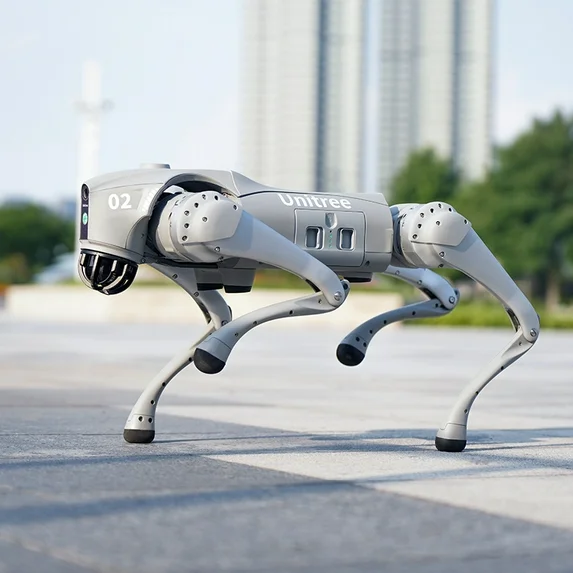
China is not waiting for that question to be fully resolved. Chinese defense firms, building on the commercial success of companies like Unitree whose consumer robot dogs start under $2,000, have been weaponizing quadruped platforms with rifles and grenade launchers at a pace that makes Western development look restrained. The PLA has conducted urban warfare exercises featuring robot dog squads advancing alongside infantry. The low cost — some Chinese platforms under $30,000 per unit — means deployment at scale that overwhelms traditional defenses is already within reach. This asymmetry in price and scale between American and Chinese robot dog platforms is one of the less-discussed but more significant strategic realities of the current competition in autonomous systems.

The line wasn’t debated—it moved. As incentives outpace ethics, autonomous weapons are advancing faster than the rules meant to control them.
The Ethical Line That’s Moving
In October 2021 — the same month Ghost Robotics unveiled its armed platform at the Army conference — Boston Dynamics and a coalition of major robotics companies published an open letter calling on governments and militaries to refrain from weaponizing commercially available robotic platforms. The letter argued that adding weapons to remotely operated quadrupeds capable of navigating civilian environments creates new categories of risk and undermines public trust in technology that has enormous legitimate potential.
That letter was published four and a half years ago. Since then, armed robot dogs have been deployed in the Middle East, tested by Marine special operators, used in the conflict in Gaza, and demonstrated at military exercises in multiple countries. The ethical line the letter tried to draw has not held — not because the argument was wrong, but because the strategic incentives on multiple sides are more powerful than voluntary industry commitments. What’s missing is the governance architecture: clear, legally binding rules about when and where autonomous weapon systems can engage, what level of human oversight is required before lethal force is authorized, and how accountability is assigned when an autonomous system causes civilian harm.
The Department of Defense maintains that it follows Directive 3000.09, which requires human judgment in the engagement decision loop. But as AI targeting systems improve and reaction time pressures increase — particularly in counter-drone scenarios where the threat may be moving at 200 miles per hour — the practical space for meaningful human decision-making narrows. The gap between “human in the loop” as a policy commitment and “human in the loop” as an operational reality is worth watching very carefully.
Where This Goes From Here
The near-term trajectory of robotic dog security is relatively clear. Costs will continue to fall as manufacturing scales — Chinese platforms are already demonstrating that functional quadrupeds can be produced at a fraction of current American market prices. Battery life will extend. AI decision-making will improve. Sensor packages will become more sophisticated and more miniaturized. The platforms will become faster, more durable, and better at navigating the edge cases — rain, ice, crowds, unpredictable terrain — that still create occasional failures today.
In the private sector, the data center and critical infrastructure market is the immediate growth driver, but the addressable market extends much further: utilities, ports, airports, pharmaceutical manufacturing, mining operations, and any high-value industrial facility that currently deploys large numbers of security guards across difficult terrain. The economic case becomes more compelling as costs fall and capabilities improve, and there is no structural barrier to widespread deployment in these environments within a five to ten-year window.
In law enforcement, the deployment trajectory will depend heavily on how the public policy debate evolves. The use cases where robot dogs clearly save lives — explosive disposal, armed standoffs, hazardous materials — will continue to expand with relatively little controversy. The use cases involving routine patrol and public surveillance will face ongoing resistance and will require transparent governance frameworks before they achieve broad acceptance. Cities that get this right will benefit from genuinely improved public safety capabilities. Cities that get it wrong will face the kind of backlash that sets adoption back years.
In military applications, the swarm capability that is already being demonstrated in China — where large numbers of coordinated autonomous platforms operate together as a tactical unit — represents the most significant near-term development. A single robot dog is a useful tool. A hundred robot dogs moving in coordinated autonomous formation, sharing sensor data in real time, covering multiple approach vectors simultaneously, is a different category of military capability entirely. The Pentagon’s Replicator Initiative — explicitly aimed at fielding thousands of autonomous systems across multiple warfighting domains — signals that U.S. military planners understand this and are working to close the gap.
The robot dog on patrol at Mar-a-Lago in November 2024 was doing something modest by future standards: walking a perimeter, transmitting video, doing its job quietly and without incident. That quiet competence is what makes the platform so significant. It works well enough to be trusted with real operational responsibility, costs less than the human it partially replaces, never loses focus, and gets better every year. The question for the decade ahead isn’t whether these machines will be central to how we think about security. They already are. The question is what kind of security we want them to provide, in whose hands, under whose authority, and with what limits on what they’re allowed to do when they decide — or are told — that a threat requires more than just watching.
Related Reading
Robot Dogs Priced at $300,000 Are Now Guarding the Country’s Biggest Data Centers
Fortune — The surge in data center adoption, the economics, and Boston Dynamics’ view of the market opportunity
Police Robot Dogs Raise Concerns as More Departments Adopt Them
Governing / Bloomberg — The law enforcement deployment landscape, civil liberties concerns, and the debate over appropriate use
Army Testing Robot Dogs Armed with AI-Enabled Rifles in the Middle East
Military.com — The armed platform deployment, Ghost Robotics’ Vision 60, and what it signals about the military’s direction