
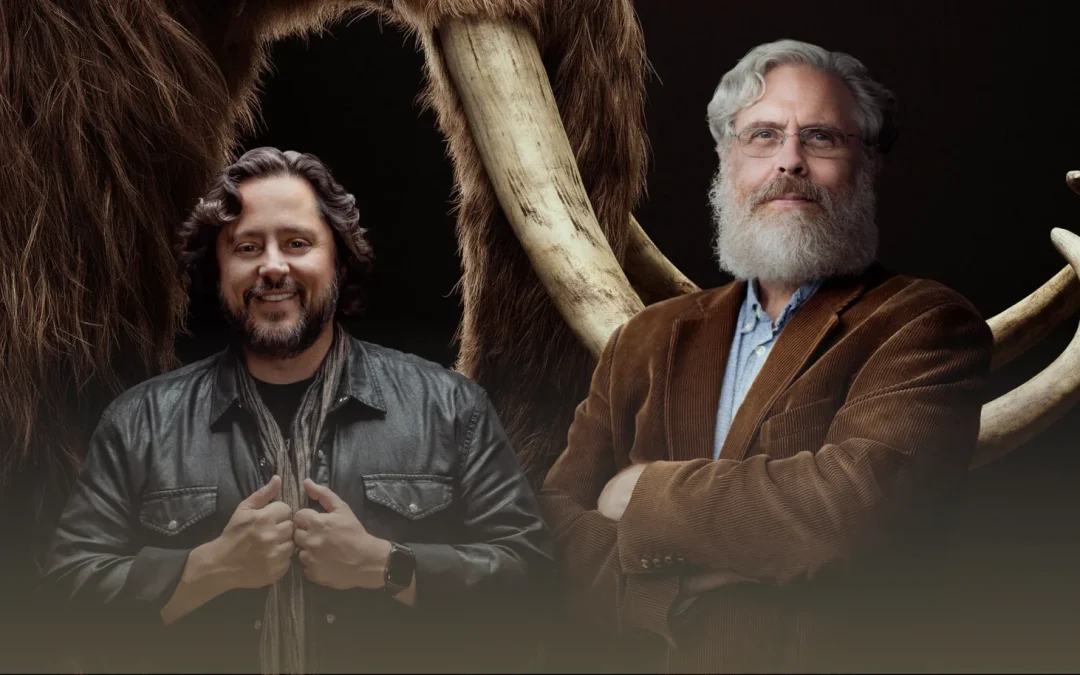
Ben Lamm (left) and George Church (right) pose in front of a woolly mammoth.
By Futurist Thomas Frey
When Colossal Biosciences launched in 2021, one of the first things Ben Lamm did was sit down with his team and map out all the software they would need to actually do the work. The list came to 55 different applications and algorithms. Fifty-five separate tools, each handling a different piece of the research pipeline, none of them talking to each other particularly well, none of them designed for the kind of work Colossal was trying to do.
There was no single platform that could take a scientist from a raw idea all the way through data analysis, workflow management, result visualization, and collaboration with researchers at other institutions. Not for this kind of biology. Not at this scale. Not with the complexity that de-extinction research demands.
So they built one.
And then — almost by accident — they realized they’d built something the entire life sciences industry had been waiting for.
The Problem Nobody Had Solved
Here’s what biological research actually looks like inside a modern lab, away from the glamour of the headlines. A scientist has a dataset — maybe a genome sequence, maybe the results of a CRISPR editing experiment, maybe microarray analysis from a gene therapy trial. That dataset is enormous. It connects to other datasets. It needs to be analyzed using computational models, cross-referenced with other results, validated through additional experiments, and eventually shared with collaborators at other universities or companies who are using completely different software systems.
In most labs today, that process is held together with institutional knowledge, personal preference, and a lot of custom code that one specific researcher wrote and that no one else fully understands. When that researcher leaves, a piece of the lab’s institutional memory walks out the door with them.
The situation at Harvard, where Colossal’s co-founder George Church runs one of the world’s most advanced genetics labs, was typical. Fifty-five different data systems in active use. Researchers from Colossal and Harvard trying to collaborate, but with no common infrastructure for sharing experiments, workflows, or results in a way that was consistent and reproducible.
“There was no cohesive solution,” said Kent Wakeford, who became co-CEO of Form Bio when it spun out. “So we developed one.”

Science is becoming software. When biology runs on integrated platforms, discovery accelerates, collaboration scales, and the real breakthrough isn’t the experiment—it’s the infrastructure powering it.
What Form Bio Actually Does
The simplest way to describe Form Bio is this: it’s what happens when you apply software product thinking to the workflow of science.
Scientists aren’t typically software engineers. The tools they use were mostly built by other scientists or small academic teams, optimized for specific tasks, and never designed to work together as a system. Form Bio replaces that patchwork with a single integrated platform — one place where a researcher can design an experiment, run computational analysis using AI and machine learning models, visualize the results, and share everything with collaborators anywhere in the world, with proper permissions and data security built in.
George Church, who has spent decades running one of the most productive genetics labs on the planet, put it plainly: the platform is “critical to pave the way” for the kind of science that’s now becoming possible. When one of the architects of modern genomics says your software is necessary infrastructure, that’s not a testimonial. That’s a signal.
The use cases stretch well beyond de-extinction. Drug discovery. Gene therapy development — specifically the design of AAV vectors, which are the delivery vehicles used to get gene-editing tools into human cells. Biomanufacturing. Agricultural biotech. Academic research across every field that generates large biological datasets, which is most of them now. The CIA’s venture arm, In-Q-Tel, invested in Colossal specifically — by their own admission — not because of the mammoths, but because of the underlying capability. The computational biology infrastructure is what interested them.
The Pattern Behind the Spinout
Form Bio was spun out of Colossal in September 2022 with a $30 million Series A that was oversubscribed — meaning investors wanted in faster than the round could close. It launched as an independent company with its own leadership team, its own staff, and its own capital structure, while maintaining a close relationship with Colossal as both a customer and a co-development partner.
This is a pattern worth paying attention to, because it’s not an accident. Lamm has been explicit that Colossal’s long-term strategy involves spinning out the technologies built in the process of doing the research — letting each tool become its own company, raise its own capital, and pursue its own market, rather than trying to run everything under one roof.
It’s the same instinct that made NASA’s technology transfer program one of the most productive sources of commercial innovation in American history. When you’re solving genuinely hard problems at the frontier of what’s possible, you generate tools that have value far beyond the original problem. The question is whether you’re organized to capture that value. Lamm is organized to capture it.
Form Bio is the first example. Breaking — the plastic degradation company built on Colossal’s synthetic biology infrastructure — is the second. Astromech, the predictive biology AI that surfaced publicly just last week, is the third. Each one started as internal tooling built to solve a specific problem inside Colossal. Each one turned out to be a product.

Form Bio was born trying to bring back a woolly mammoth. Where it ends up may be considerably larger than that.
Why This Matters Beyond Biology
There’s a larger story here about what happens when software thinking meets science.
Academic research has always moved slowly, and part of the reason is structural. Scientists work in relative isolation, each lab developing its own methods, its own tools, its own ways of doing things. Reproducibility — the ability for another lab to run the same experiment and get the same result — is one of the most persistent problems in modern science, and a lot of it comes down to the fact that the computational infrastructure for sharing and standardizing workflows simply hasn’t existed.
Form Bio is building that infrastructure. The comparison its co-CEO reached for was GitHub — the platform that transformed software development by giving programmers a shared environment for building, testing, and collaborating on code. What GitHub did for software, Form Bio wants to do for biology. Create a common layer. Make the workflows reproducible. Let researchers spend their time on science instead of on data wrangling.
That’s not a small ambition. Biology is becoming the defining technology of this century in the same way that computing defined the last one. The platform that becomes the operating system for biological research — the place where scientists from Cambridge to Tokyo to Dallas all run their experiments and share their discoveries — will be one of the most consequential pieces of software infrastructure ever built.
Up Next: Breaking — how Colossal’s synthetic biology toolbox turned into a potential solution for 5,000 million tons of plastic.
Related Reading
When the CIA Invests in De-Extinction, Read the Fine Print
In-Q-Tel — The intelligence community’s venture arm explains why it backed Colossal — and makes clear the investment was about computational biology capability, not the animals
The Data Deluge Threatening to Drown Modern Science
Nature — A foundational look at why biological research generates more data than scientists can currently process, and why the tools to manage that data have become as important as the science itself
GitHub for Science? The Race to Build Research Infrastructure
MIT Technology Review — How a new generation of platforms is trying to do for biological research what GitHub did for software development — and why the stakes are higher than most people realize