
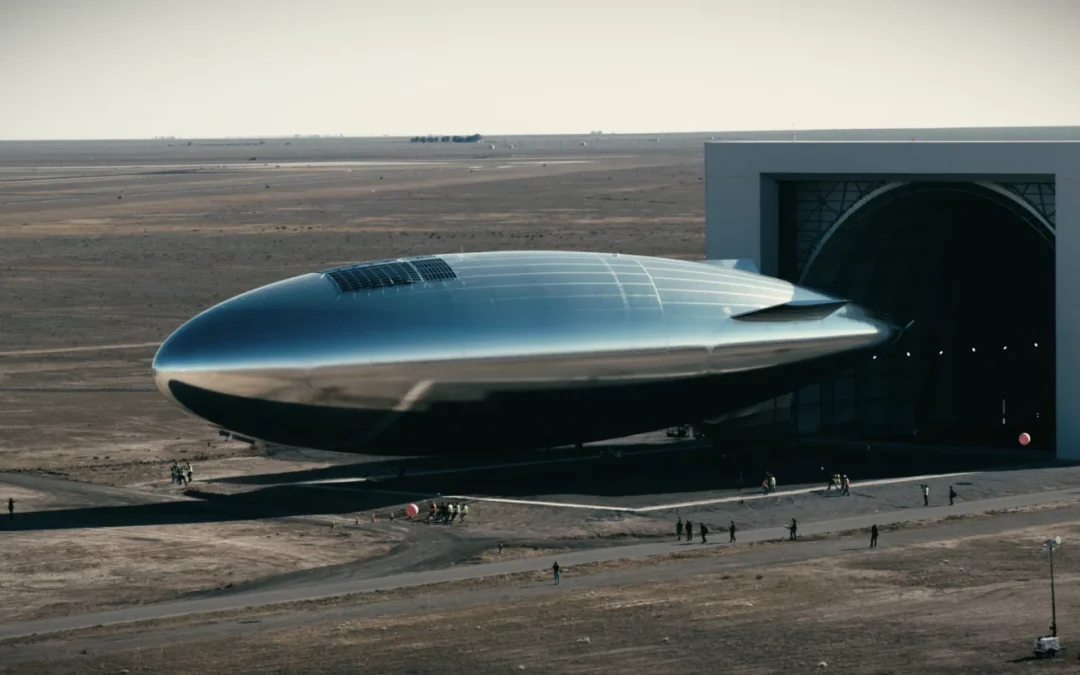
A solar airship at 52,000 feet, flying for days without fuel-
quietly redefining persistent observation and reshaping how we watch the world.
By Futurist Thomas Frey
Somewhere above the coast of Brazil last week, a 270-foot solar-powered airship was floating in the stratosphere at 52,000 feet, watching. Not a satellite. Not a drone. Not a plane. An autonomous, unmanned airship that had been aloft for twelve days, powered entirely by sunlight during the day and lithium-sulfur batteries at night, maintaining its position with a station-keeping radius of less than a kilometer.
It had departed Roswell, New Mexico on March 25th and traveled 6,400 miles across the Gulf of Mexico and into Brazilian airspace before completing its mission on April 6th with a controlled descent into international waters. No pilot. No fuel stops. No refueling. Just the sun, the wind, and a platform that is quietly rewriting what persistent aerial observation means for the planet.
The company behind it is called Sceye — pronounced “sky” — and what it’s building may be one of the most consequential technologies nobody outside the aerospace world is paying attention to yet.
What Sceye Actually Is
The concept isn’t entirely new. The US government spent billions of dollars in the 1990s and early 2000s trying to build a stratospheric airship capable of sustained station-keeping at high altitude. Every attempt failed. The technology simply wasn’t there — the materials were too heavy, the batteries couldn’t store enough energy to survive the night, and the engineering challenges of maintaining pressure and position through the violent temperature swings of the day-night cycle defeated every program that tried.
What changed was materials science. Graphene and advanced composites made the envelope light enough. Lithium-sulfur batteries reaching 425 watt-hours per kilogram made night operations viable. Solar cell efficiency crossed a threshold that made the energy math work. Sceye’s founder, Mikkel Vestergaard Frandsen — a Danish social entrepreneur better known for building mosquito net and water purification businesses for developing nations — read about high-altitude platform systems through a NASA technology transfer program and realized that several previously impossible things had quietly become possible.
He started the company in 2014, built a nine-foot prototype in 2016, scaled iteratively to 70 feet, then larger, then larger again. By 2021 the airship reached the stratosphere for the first time. In 2024 it completed a full day-night power cycle in the stratosphere — the milestone that proved the energy system actually worked. This spring’s 12-day mission to Brazil was the next step: proving the platform could sustain operations over multiple day-night cycles far from home base, over a range of atmospheric conditions, at stratospheric altitude.
The company’s first pre-commercial test flight is scheduled for this summer in Japan, in partnership with SoftBank, demonstrating high-speed connectivity from the stratosphere for emergency and disaster response. The long-term goal is an airship that can stay aloft for up to 365 days continuously.
A permanent, solar-powered platform hovering at the edge of space. Watching everything below it. Forever.

Stratospheric platforms fill the gap: satellite-scale coverage with aircraft-level detail—unlocking real-time monitoring, connectivity, and surveillance across regions no system could previously reach.
Where the Biggest Opportunities Are
The stratosphere sits at a uniquely valuable altitude. High enough to see hundreds of square miles simultaneously. Low enough to resolve detail that satellites cannot. Above commercial air traffic. Above the weather. Below the orbital mechanics that require satellites to keep moving rather than staying fixed over one location.
That combination unlocks applications that neither satellites nor conventional aircraft can currently serve.
Environmental monitoring is the one that’s already generating commercial traction. Sceye’s infrared sensors can detect methane emissions from oil and gas operations with a resolution of one meter — compared to the European Space Agency’s Sentinel-5 satellite, which sees methane in pixels each representing seven square kilometers. The difference is the difference between knowing there’s a pollution problem in a region and knowing that well number 62 from a specific company has been leaking 68 kilos of methane per hour for the last twelve minutes. In a test flight over New Mexico last year, Sceye identified a single super-emitter in Texas releasing an estimated 1,000 kilograms of methane per hour — the equivalent of 210,000 cars running simultaneously. That data went to the EPA.
Wildfire detection is equally compelling. A persistent stratospheric platform can watch thousands of square miles continuously, identifying heat signatures and smoke patterns within minutes of ignition rather than waiting for a satellite pass or a fire lookout to spot the smoke column. In a world where wildfire behavior is becoming increasingly severe and unpredictable, early detection measured in minutes rather than hours changes the entire response calculus.
Telecommunications access for underserved regions is the application that attracted SoftBank. Sceye’s SceyeCELL antenna performs real-time beam forming from the stratosphere, delivering high-speed connectivity across vast areas without the infrastructure investment that terrestrial networks require. For regions with no cell towers — remote coastlines, disaster zones, island nations, frontier territories — a single Sceye platform provides coverage that would otherwise require years and billions of dollars of ground-based infrastructure to build.
Beyond those, the platform is a natural fit for maritime surveillance — tracking illegal fishing, monitoring shipping traffic, watching for smuggling across vast ocean expanses where no radar network reaches. Precision agriculture monitoring across regional scales. Hurricane and severe weather observation from above the storms rather than through them. Arctic and Antarctic observation for climate science. Border monitoring. Oceanic health assessment. The list extends as far as the applications of persistent, high-resolution, wide-area observation extend — which is very far indeed.
The Dangers Worth Understanding
A platform this capable of observation is also, by definition, a surveillance platform. The same technology that watches methane leaks can watch people. The same resolution that identifies a specific gas well can identify a specific vehicle, a specific individual, a specific gathering of people.
The question of who operates these platforms, under what legal framework, with what oversight, and with what constraints on the data collected is not a question the technology answers. It’s a question societies will need to answer before the platforms become as common as the applications suggest they could become. The regulatory frameworks for stratospheric platforms are almost entirely undeveloped. The airship operates above the altitude where standard aviation regulations apply, but below the altitude of orbital satellites, which have their own legal regime. The gap between those two frameworks is where Sceye currently operates, and it’s a gap that will require deliberate governance as the industry matures.
There are physical risks too. A 270-foot helium-filled vehicle descending from 52,000 feet carries real hazard to whatever is below it if something goes wrong. Sceye’s controlled termination of this mission into international waters reflects careful planning around that risk — but commercial operations over populated areas, ocean shipping lanes, and sensitive ecosystems will require failure mode analysis that goes well beyond current aviation standards.
Helium supply is a genuine long-term constraint. Helium is a finite, non-renewable resource. A world with thousands of stratospheric airships in continuous operation would put significant pressure on helium supply chains that are already under strain. Hydrogen is the obvious alternative — vastly more abundant, producible renewably — but hydrogen’s history with lighter-than-air flight includes a disaster that shaped public perception of the technology for nearly a century. Solving the hydrogen safety problem for stratospheric operations is technically tractable but not trivial.
When Will Average People Experience This?
The honest answer is that average people will experience the effects of this technology long before they experience it directly.
The methane monitoring that prevents a super-emitter from pumping greenhouse gases for months undetected — that’s an invisible benefit most people will never attribute to a stratospheric airship. The wildfire that gets caught at two acres instead of two thousand because a persistent platform spotted the heat signature at 3am — same thing. The disaster response that delivers cellular connectivity to a hurricane-devastated community within hours of the storm passing — real and significant, largely invisible.
Direct public access to stratospheric platforms is further out. The technology is currently uncrewed and purpose-built for observation and communications payloads. There is no Sceye equivalent of the passenger jet — the airship’s operating environment is simply too hostile for human occupants without engineering investments that haven’t been made and aren’t currently planned.
The path to passenger stratospheric vehicles exists — several companies are working on stratospheric balloons that can carry small groups to near-space altitudes — but those are fundamentally different vehicles from what Sceye is building. Sceye’s platform is infrastructure, not transportation. It’s the equivalent of a cell tower or a weather satellite, not an aircraft.
What’s more likely is that within five to ten years, the applications Sceye enables become woven into infrastructure people interact with daily. Environmental compliance systems. Emergency response networks. Agricultural monitoring services. Maritime tracking. The stratospheric platform disappears into the background as invisible infrastructure — noticed only in the results it makes possible, not in the vehicle floating 52,000 feet above your head.

A decade of quiet iteration beat billions in failed attempts. Now solar airships work—and soon, they’ll change how the world is continuously observed.
The Bigger Picture
What Sceye has accomplished — a solar-powered, autonomous airship maintaining stratospheric altitude through multiple day-night cycles across 6,400 miles of open ocean and varied atmospheric conditions — is an engineering achievement that deserved significantly more attention than it received.
The US government spent decades and billions of dollars failing to do exactly this. A startup from New Mexico, founded by a Danish humanitarian entrepreneur with no aerospace background, figured out why those attempts failed, waited for the materials science to catch up, and built the thing iteratively and carefully over ten years.
The applications are real. The technology works. The commercial deployment is imminent.
Somewhere above Japan this summer, a 270-foot solar airship will begin demonstrating what persistent stratospheric observation looks like at scale. The world below it will look quite different through those sensors than it does from any vantage point we’ve had before.
Related Reading
High-Altitude Platform Systems and the Future of Global Connectivity
International Telecommunication Union — The technical and regulatory framework for high-altitude platform systems, including frequency allocations, altitude definitions, and the international coordination challenges of stratospheric operations
The Methane Hunters: How New Technology Is Finding Invisible Emissions
Nature — A comprehensive look at the technology landscape for methane detection — satellites, drones, aircraft, and ground sensors — and why persistent stratospheric monitoring fills a gap none of the others can
The Surveillance Problem at the Edge of Space
Brookings Institution — An examination of the legal and governance vacuum around stratospheric observation platforms, and what regulatory frameworks will need to develop before the technology can be deployed responsibly at scale